The Story Behind Imagine That Creations
My journey began with my son. From the moment he was born, he was a joyful, happy little soul, but something always felt a little different. While other children met their milestones, mine didn’t. He didn’t babble, he didn’t crawl when other babies were crawling, and he always seemed just a little behind. Everyone told me not to worry, that he’d get there in his own time. But deep down, I knew something more was going on.
He didn’t start speaking until he was four. Crawling only began around two and a half, and even then, it lasted just a few weeks before he pulled himself up and started walking. At the time, I thought it was clever. I was proud. I didn’t realise that skipping key stages of development, like crawling, could signal deeper neurological delays. It wasn’t until much later, after countless hours of research, that I discovered what had really been happening: his primitive reflexes had not integrated. And this lack of integration was at the root of so many of his challenges.
By the time my son was seven, the differences between him and his peers were undeniable. While still the happy little boy we loved, he struggled immensely. His speech was delayed and unclear. Learning to read and write felt impossible. He couldn’t ride a bike, couldn’t coordinate his legs to pedal, struggled with catching a ball, and constantly tripped, sometimes over nothing at all. It was like he didn’t know where his body ended and the world began.
That same year, we discovered he had been experiencing absent seizures since infancy. It was a revelation that finally connected the dots, and possibly explained why his brain hadn’t had the chance to properly develop the foundational patterns needed for growth. Medication was necessary, but I didn’t want to rely on that alone. I wanted to bridge the gap, the growing chasm between my son and his peers.
And so began our three-year journey of developmental movement integration therapy. Every day, we worked through repetitive exercises designed to integrate specific reflexes. Each one took at least 40 days, and one, I remember clearly, took over 270 sessions before he mastered it. It was exhausting. There were tears, battles, moments of frustration, and countless days of wanting to give up, but we didn’t.
At the same time, we introduced auditory retraining to address his auditory processing disorder. He had still been hearing primarily through bone conduction. We used Integrated Listening Systems, specific frequency-tuned music, like Beethoven, designed to stimulate brain plasticity and grow new neural pathways. It sounded like science fiction. But it worked.
Within a month, the changes were undeniable. His teachers noticed. I noticed. It was like a switch had been flipped. The child who once seemed lost in his own world was suddenly here, awake and alert to the world around him.
I’ll never forget the day we were driving through town and he pointed to the large old town clock and asked, “Mum, when did that get put up?” I told him it had been there for over a hundred years. “Wow,” he said, “I never noticed it before.” It was such a small moment, but to me, it was massive. His world had finally opened up.
He started balancing better. He could suddenly walk on stilts at school. He stopped tripping over his own feet. It was the kind of progress we never thought we’d see, and it all came from going back to the beginning, to the foundational movements all babies should experience.
Through all of this, I began to see a deeper truth: our kids are losing so much to technology. They’re sitting more, moving less, and playing even less. Screens have replaced real play, and that’s robbing children of essential developmental milestones. I realised that imaginary play, movement, and body awareness weren’t extras, they were essential.
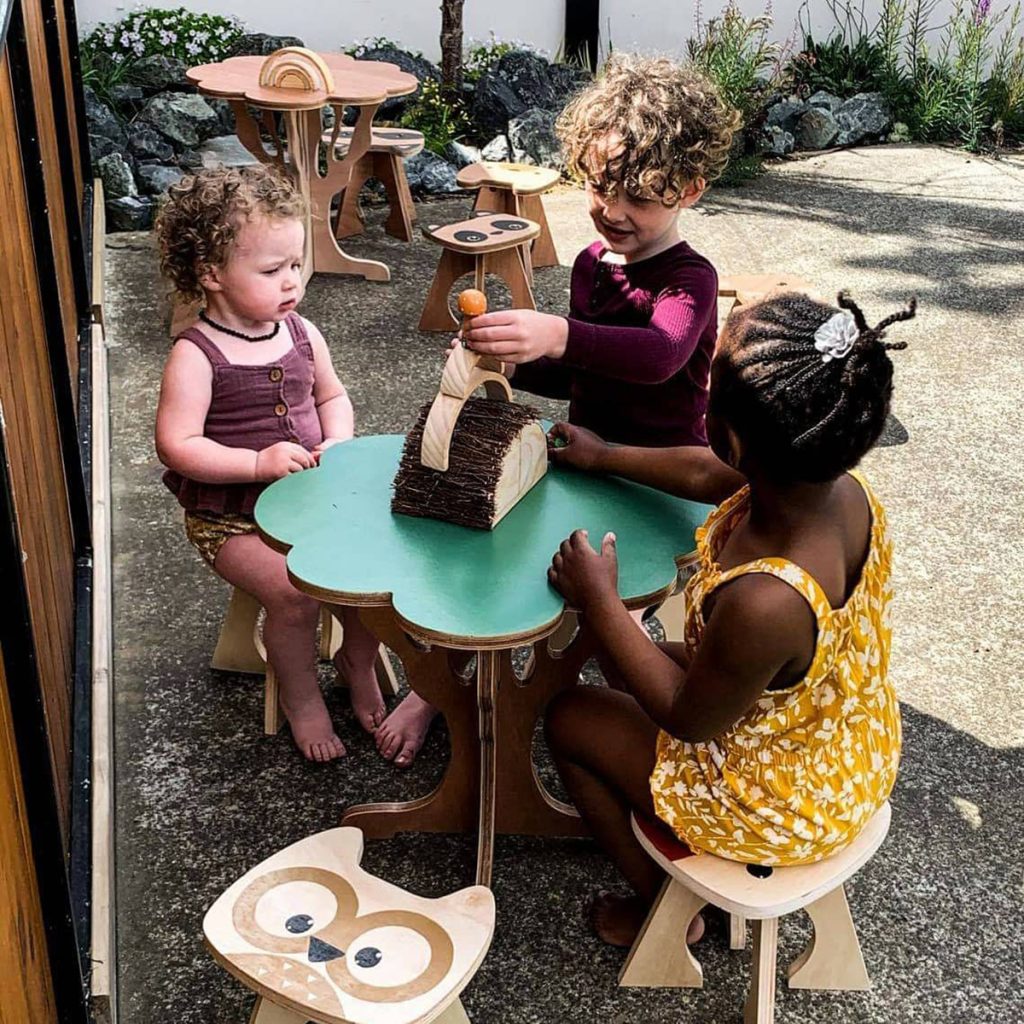
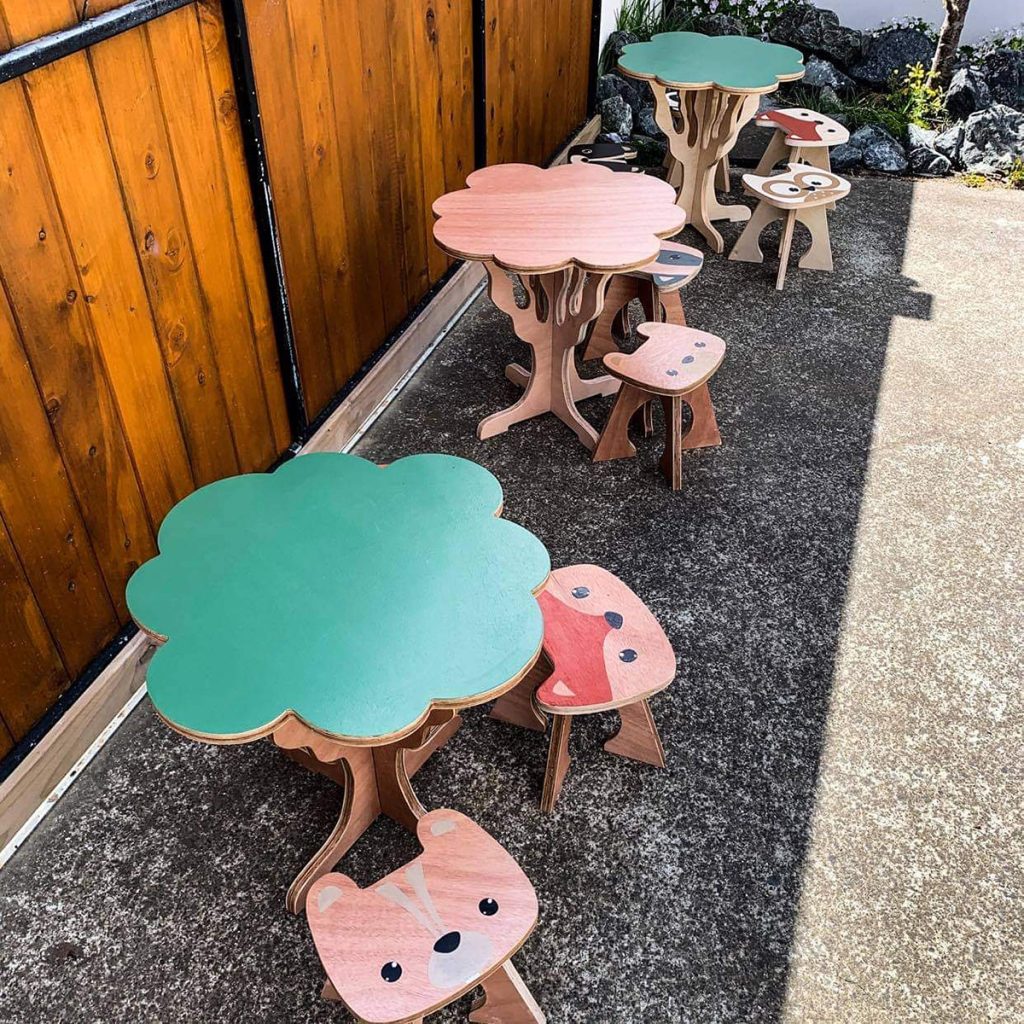
Because I’m deeply connected to nature, and inspired by the Montessori principles of hands-on, purposeful play, I wanted to create something that embodied all of this: developmental integration, sustainability, and imagination. That’s how my first design came to life, a beautiful, organic tree-shaped table paired with stools designed not just for play, but for purpose.
The stools are more than furniture, they support core strength and balance. By allowing children to plant their feet and move naturally, they encourage integration of the same reflexes we worked so hard to master in therapy. And because stools don’t restrict children the way chairs do, they allow for the wiggle, the fidget, the movement, all the things children need to thrive. So many kids are told to sit still and be quiet. But movement is how children learn, focus, and regulate. The right kind of furniture can support this beautifully.
The table and stool set gives children a natural, inviting destination to begin their play. But we didn’t stop there. At Imagine That, we also design products that help spark the imagination and get the creative juices flowing. Our woodland cottages and little pig houses are designed to be open-ended, they can be anything a child dreams up. A tiny moth cottage. A boat flipped upside down. A garage for toy cars. That’s the beauty of imaginary play: it’s unstructured, open, and driven by the child’s own ideas. Our products are designed to be mixed, matched, reinvented, because imagination doesn’t come in a box, and it definitely doesn’t need to match a set.
That’s why I founded Imagine That Creations. Not just to build beautiful play-based products, but to support children’s development through design. I wanted to create tools that give parents and educators an easier, more joyful way to nurture a child’s growth. Products that encourage children to move, imagine, create, and thrive.
While I’m not a qualified therapist in developmental movement, my journey as a parent and advocate has given me something just as valuable, firsthand experience. I’ve lived it. I’ve walked alongside my child every step of the way. And that journey has given me a deep appreciation for the importance of imaginary play, developmental movement, and anything that helps children break free from screens and engage with the real world around them.
And that’s where my story pauses, for now. But Imagine That is just getting started.